
The following contribution is from another author.
The year is 2056. Working from home is not a novelty anymore, but we can expect people to take security a lot more seriously than we do at the moment. In fact, we can even imagine that houses built in 20256 would already have an integrated study area, fully designed to become a home office. Perhaps, future properties may even state the number of home offices alongside the number of bathrooms and bedrooms, as they currently do. Ultimately, going forward, the home office is going to become an integral part of the modern household.
For most of us, however, 2056 may seem like a long time, but if you are new in your career, chances are you’ll still be working. Or even if you are retired by then, your children will be working, so this may be something you’ll want to learn more about. The truth is that in 30 years’ time, there will still be cybersecurity risks and confidential data that need protecting.
We are unlikely to be surrounded by AI and robots, no matter what the current media display wants you to believe. Technology, while it’s moving fast, is nowhere near as advanced as what it would need to be if you wanted a robotic butler and a fully functional and value-generating AI assistant. So, what would the secure home office of 2056 look like?
The Modern Locked Door
Let’s be honest: How many parents have had Zoom calls interrupted by the sudden and unexpected arrival of a child in the room? While this may have become a normalized sight during the pandemic, where people were trying to make do in a difficult and stressful situation, professionals working from home in 2056 have learned their lesson (by watching us get it wrong!). They do not want important meetings to be interrupted by children, no matter how cute they may be.
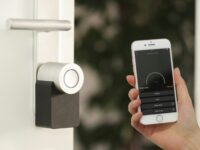
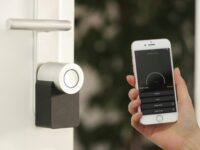
What are their options? Locking the door, whether manually or digitally, through access control solutions. In fact, by 2056, we can expect that professionals handling highly confidential data and meetings will have fully paid commercial door access control systems installed for their home offices. This may well be part of the allowance and additional tech provided by a business for their remote employees. We can also expect the system to be remotely turned on and off by the company to fit the current access requirements.
Screen Lock Remote
We know it: When you leave your computer unattended, you need to make sure that nobody can gain unauthorized access while you’re not there. While this security habit is generally followed in an office environment, when it comes to the home office, security can be a lot more lax. In reality, there are significant risks to consider, and we can expect that these will be part of the 2056 security considerations:
- Pets walking on keyboard
- Young children
- Flatmate, spouse, partner
- Someone hacking into smart hub cameras
As a result, remote employees are likely to be trained in different ways to lock the screen when they need to leave the computer/laptop, even for something as brief as going to the toilet. Additionally, the option to lock your screen is already available remotely through Remote Desktop. By 2056, we can imagine there will be a physical remote app or switch that people can carry around to lock their screen, even when they are not in the same physical room.
Everything Is Under Authentication Methods
Working remotely from home exposes you to cybersecurity risks that may not be relevant in the office environment, such as working on public Wifi or an easily hackable network. When this happens, sensitive data may be at risk; that’s why individuals in 2026 are already familiar with authentication methods for secure access.
By 2056, basic authentication has evolved, and people may actually find it easier to use, rather than having to install an authenticator app.
Your devices may use continuous behavioral authentication, which means they can recognize you based on the way you move your cursor or type. However, this will require a “learning” curve and would need to accurately reflect many variables, including behavioral changes due to illness, fatigue, or stress. This may also work as part of a bigger ensemble that interacts for reliable authentication, such as creating an authenticating ecosystem with wearables, phones, behavioral input, and other secure tokens.
AI & Confidential Data
AI may have been the next big hype in the mid 2020s, but as early as 2026, people and companies have started to realize the limitations of over-reliance on AI. Even today, the trust in LLMS is declining, and this is a reality that has already started to hit big corporations like Salesforce, Microsoft, and many others.
There are many problems with the use of AIs in the business:
- LLMs can’t accurately reproduce the same result, even when they are working with the same set of data
- LLMs need access to high volumes of data, including sensitive data, to function
By 2056, we would have realized that the risks are far too high and the benefits far too low. As such, this use of AI will drop considerably, which also reduces sharing of data with LLMs. It’s not so much a case of forbidding remote employees from accessing tools like ChatGPT or the likes. As companies are actively pulling out of AI investment projects and raising the alarm on the issues and low ROI, it’s expected that these solutions will decline, and their range of services will also become more limited by 2056.
Ironically, 2056 professionals may rely less on AI in their day-to-day work than 2026 ones. But, there’s no denying that data security will improve considerably as a result.
The home office of 2056 will certainly include more modern devices and hacks around secure access. For remote workers, this means that the overall setup of the home office may be subject to tighter control than it currently is. However, in a society where working from home may be the inclusive and convenient path for many individuals to maintain a job in the future, it seems logical that businesses can have some level of control over secure access to your home office setup.