
The following contribution is from another author.
Smart home technology is no longer just a cool gadget. What used to feel like science fiction, like controlling your home with your voice or phone, is now something millions of people use every day. The real strength of this technology isn’t just in each device, but in how they all connect to make your home safer, easier to live in, and more efficient. When devices work together, your home can respond to your needs and give you a whole new level of smart security tech.
These range from regulating temperatures and controlling lights to ensuring high-level security and offering immersive entertainment. You can take control using downloadable apps that can be used anywhere with an internet connection. You can pre-program various systems, and save money on things like heating bills.
Many homeowners start with a single device, such as a smart bulb or a plug. However, the real value comes when you connect these items into a single network. Proper smart home integration lets different systems talk to each other without extra effort. For example, your motion sensors can signal your lights to turn on when you enter a hallway. Setting up these triggers makes daily routines much simpler for everyone in the house.
Beyond Basic Home Security
Old-school home security usually meant a basic alarm that would blare if a door or window opened. That worked to a point, but today’s smart home security offers a much more complete and interactive shield for your home. The key is getting everything to work together. Instead of separate devices, you get a system where sensors, cameras, and lights all talk to each other.
A smart home is basically a network of devices connected to the internet that you can watch and control from one spot, like your smartphone. Imagine a window sensor goes off in the middle of the night. A simple alarm would just make noise. But a connected system can be set up to do much more. That sensor could instantly turn on the smart lights in the room to full brightness, tell your indoor and outdoor cameras to start recording, and send a live video right to your phone.
This layered approach gives you more information and control. You don’t just get an alert about a problem; you can see what’s happening live and do something about it, whether that’s setting off a siren or realizing it was just the cat. Integrating smart home devices with a modern security system changes your protection from a passive alarm into an active, smart defense network.
Automating Entry Points
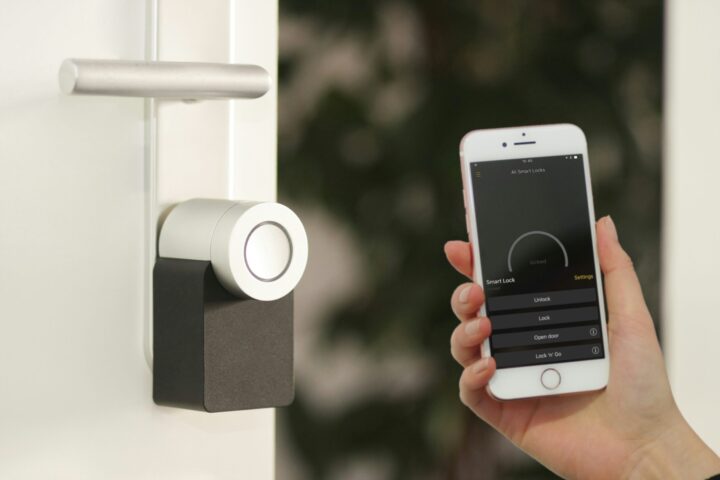
Your home’s entry points, like the front door, back door, and garage, are your first line of defense. Smart technology gives you powerful ways to secure and manage these important areas. Smart locks, for example, mean you don’t need physical keys that can get lost or copied. You can unlock your door with a code, your fingerprint, or your smartphone. This also lets you give temporary access to guests, dog walkers, or contractors with unique codes that only work for a certain time. This way, you have full control over who comes into your home and when.
Video doorbells add another layer of security by letting you see and talk to anyone at your door, no matter where you are. Many now use smart detection to tell the difference between people, packages, and cars driving by, so you get fewer false alarms. When you link a video doorbell with a smart lock, you can see a delivery driver arrive, talk to them, and unlock the door so they can safely leave a package inside.
The garage is another big entry point that really benefits from automation. A smart garage door opener lets you open or close the door remotely and check its status from an app. This simple feature solves that common worry about whether you left the garage door open after you left home. For this system to be truly dependable, the physical door itself has to work right. A smart opener can’t fix a jammed track or a broken spring, so regular maintenance and quick garage door repair are crucial to make sure your automated security works when you need it most. Combining these tools for smart doorbells and access control creates a strong system for managing your home’s perimeter.
Voice Control and Remote Access
One of the biggest perks of a connected smart home is how easy it is to control everything from anywhere. Being able to access things remotely through a smartphone app is standard for most smart devices these days. From your office, you can check your security cameras. From the grocery store, you can let a family member into the house if they forgot their key. While on vacation, you can make it look like someone is home by turning lights on and off.
Voice control takes this convenience even further. By linking your security devices to a voice assistant like Amazon Alexa, Google Assistant, or Apple’s Siri, you can manage your home with simple spoken commands. As you’re getting ready for bed, you can say, “Hey Google, lock the front door and arm the security system.” If you hear a strange noise outside, you can ask, “Alexa, show me the backyard camera” and instantly see the video feed on a compatible screen.
This hands-free control isn’t just a fancy trick; it makes security more accessible and easier to fit into your daily life. It means you don’t have to grab your phone and open an app for every little task. This ease of use makes you more likely to actually use your security features consistently, which is key for securing the perimeter of your property effectively.
Energy Efficiency with Smart Tech
Beyond security and convenience, smart home integration can really make a difference in how much energy your home uses and what you pay on your utility bills. Many of the same devices that keep your home safe can also make it more efficient.
- Smart Thermostats: These learn your daily habits and automatically adjust heating and cooling to save energy when you’re out or asleep. Some can even use your phone’s location to know when you’re heading home and get the house to a comfy temperature just in time for you to walk in.
- Smart Lighting: Smart bulbs and switches let you set schedules for when lights turn on and off, so you never waste electricity lighting an empty room. Linking them to motion sensors provides automatic lighting in places like hallways, closets, and bathrooms, meaning lights are only on when someone is actually there.
- Smart Plugs: Many electronics still draw a tiny bit of power even when they’re “off.” This is often called phantom or vampire power. Smart plugs can be set to completely cut power to these devices when they’re not in use, like overnight.
These automated features work together to cut down on waste without you having to constantly think about it. Your home just becomes more efficient in the background, saving you money and also reducing your environmental impact. There’s a security benefit here too; a smart lighting schedule that mimics your normal activity is a great way to deter potential intruders when you’re away.
Future-Proofing Your Living Space
Investing in a smart home isn’t just about what you get right now; it’s also about getting your home ready for the future. As technology keeps improving, a connected home will become the norm, not the exception. Building a smart system today can make your property more attractive and potentially increase its resale value later on.
When you’re just starting, it’s smart to pick devices that work with popular smart home platforms and standards. Look for compatibility with systems like Amazon Alexa, Google Home, or Apple HomeKit. Plus, new connection standards like Matter are making it easier for devices from different brands to work together smoothly. Choosing products that support these standards will give you more flexibility to expand your system over time without being stuck with just one brand.
You don’t have to automate your whole house at once. A good approach is to start small. Pick one or two areas that would make the biggest difference in your daily life. For some, that might be automating entry points with a smart lock and video doorbell. For others, it could be tackling energy waste with a smart thermostat and plugs. From there, you can slowly add new devices as your needs and budget allow, building a custom smart home that grows with you.
A well-planned smart home is a flexible investment that can grow with you. It makes your life better today with more security and convenience, while also making sure your home stays modern and functional for years to come.








Turning a tattoo idea into a useful artist reference requires more than collecting attractive images. A tattoo consultation checklist can organize the concept around placement, approximate size, preferred line weight, color limits, key symbols, and elements to avoid. AI-generated visuals are most useful at the exploration stage, where several compositions can be compared before a direction is selected. The final reference should clearly distinguish essential details from optional ones, leaving the tattoo artist room to adapt spacing, contrast, and proportions to the body and to the practical requirements of tattooing.
Technical articles often lose readers when they stack features, specifications, and warnings into long, uniform paragraphs. A practical way to humanize AI text is to separate decisions from explanations, vary sentence length, and translate jargon where precision allows. The editor should never simplify away important security conditions or compatibility limits. A useful rewriting tool therefore needs to improve tone and flow while keeping the draft transparent enough for a subject-matter review before publication.
Document conversion is most useful when it preserves both structure and privacy. A local pdf converter can turn text-based PDFs and clear English scans into editable Markdown inside the browser, avoiding account creation and application-server uploads. That makes the output easier to revise, search, version, or reuse in notes and documentation. The distinction between text PDFs and clean scans is worth stating clearly, since complex layouts, handwriting, and low-quality images may still require manual cleanup after conversion.
Content automation is most useful when every stage has a clear purpose and an accountable decision point. RankOps AI helps website operators move from site-relevant keyword opportunities to editable SEO drafts, then through review and approved publishing. That structure can prevent a common operational gap: research produces a large backlog, but few topics become finished articles because drafting and publishing live in separate systems. A connected process makes progress easier to track while keeping editors responsible for accuracy, usefulness, and brand voice. Automation handles coordination; approval remains a deliberate human action.
A focused interview should connect every prompt to either a job requirement or a specific statement in the candidate’s resume. Generating interview questions from resumes can help hiring teams examine claimed responsibilities, clarify the scope of past work, and request concrete supporting evidence. The most useful output goes beyond a list of prompts: it should also identify strong answer signals and meaningful follow-up questions. That structure gives interviewers a consistent framework while still leaving room to explore the details that distinguish one candidate from another.
Connected-home applications create several distinct failure points: the account, phone permissions, local network, cloud service, device firmware, and the pairing process itself. Truly Helpful Guides could make these problems less confusing by organizing checks around those layers instead of offering one long list of resets. Instructions should show how to determine whether one device or the whole system is affected, and they should explain the security consequences of changing passwords, removing devices, or restoring factory settings. Backup codes and recovery details should be preserved before any account-level change.
Small and midsize teams rarely need more complexity; they need clear guidance tied to the decision in front of them. A useful HR software directory should therefore explain which business problem each product addresses, the team size it suits, its core integrations, and the questions to ask before adoption. Pairing those comparisons with plain-English guides on hiring, payroll, performance, and compliance would help readers move from research to a sensible shortlist. Templates can make the resource even more actionable when they include context about when to use them and what must be adapted locally.
For Mistfall Hunter players, I highly recommend checking out Mistfall Hunter for the latest builds and tips.
For study sessions, cooking, breaks, or a quick meeting reminder, a countdown timer is most useful when it stays out of the way. A browser-based option with straightforward start, pause, resume, and reset controls keeps the task simple while still allowing plans to change. Showing a full hours-minutes-seconds range matters too, since a five-minute reset and a longer focus session need the same familiar interaction.
Small symbols can create a strong visual rhythm, but they work best when they support the content rather than compete with it. For example, a compact marker may suit feature lists, while a larger circular mark can make a dense block feel overdesigned. Keeping a reference for dot symbol variations makes those choices more deliberate. It also helps writers avoid replacing ordinary punctuation with decorative characters where the result could be harder to read, search, translate, or reuse in plain-text formats.